Quick capture is solved. Processing isn't.
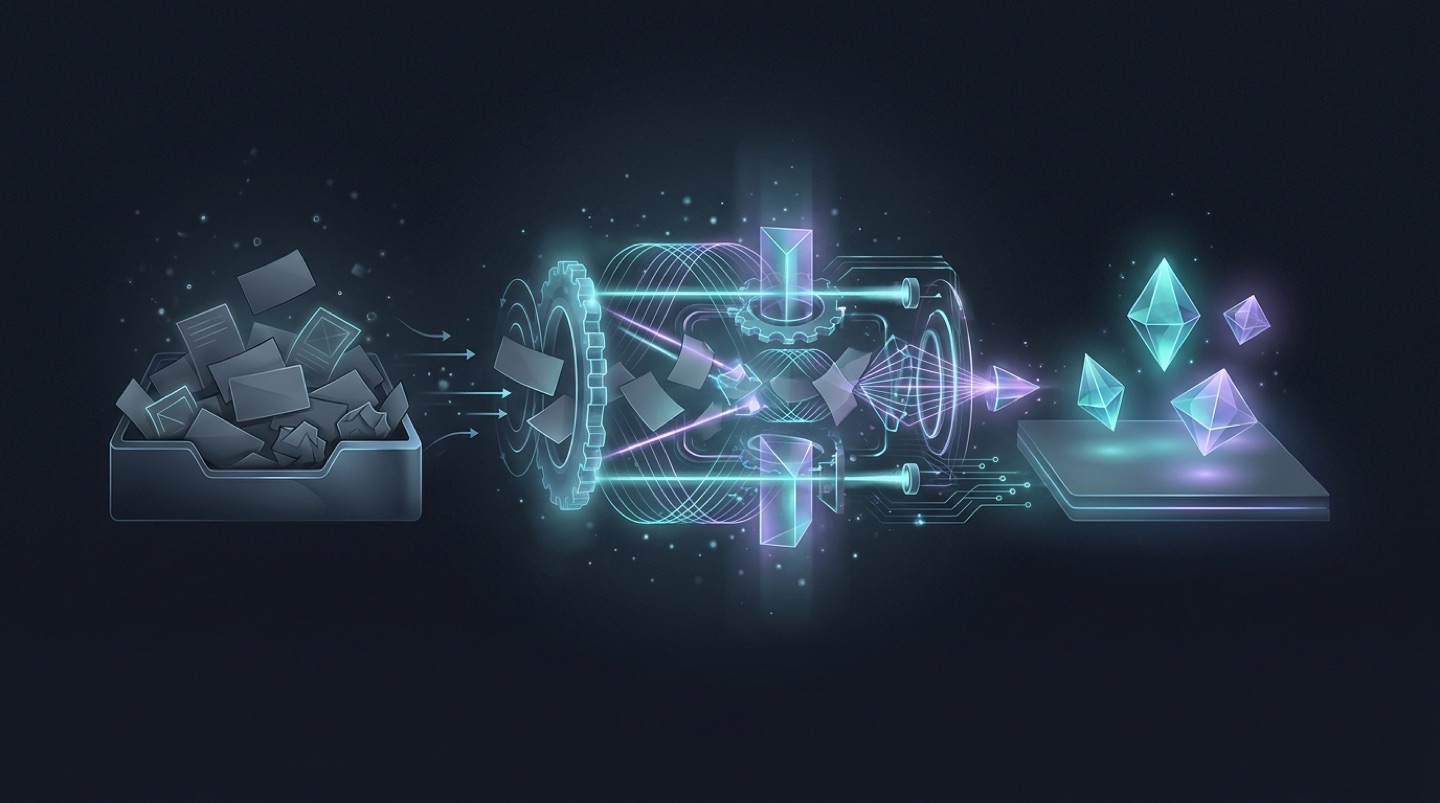
If you've built a second brain, you've solved capture. You have a global hotkey, a mobile share sheet, a daily note, an inbox that fills itself. Storage is a solved problem too — Obsidian, Notion, and friends will hold a million notes and find any of them in milliseconds. And yet the nagging feeling persists: a beautiful, searchable archive of things you never developed. That's not a capture failure or a storage failure. It's the step everyone's tooling quietly skips — processing.
The short version
- PKM tools optimize capture and storage. The bottleneck is processing — turning a fleeting note into a developed one.
- Processing is manual, effortful, and easy to defer forever — so the inbox becomes a graveyard.
- The fix isn't another vault. It's an engine that develops a note, that sits in front of your existing stack.
The pipeline everyone half-builds
GTD calls it "clarify." Tiago Forte's C.O.D.E. calls it "organize" and "distill." Zettelkasten draws the sharp line between a fleeting note and a permanent note. Every serious system names the same middle step — the moment a raw capture becomes something you've actually thought about. And every tool leaves that step to you, by hand, later. Which, on a busy week, means never.
Why processing is the step that rots
Processing is uniquely easy to defer because it's the only step that requires thinking. Capture is a reflex; storage is automatic; retrieval is a search box. But turning "interesting — AI and hiring??" into a note you've genuinely developed means sitting with it, asking what you actually mean, checking it against reality. That's real cognitive work, it has no deadline, and the tool won't do it for you — so it waits. And a fleeting note that's never processed isn't an asset. It's a line item in a graveyard you occasionally reorganize to feel productive.
What an engine does that a vault can't
A vault is passive by design — it holds whatever you put in it and asks nothing. What the missing step needs is the opposite: something active that moves a note forward. Concretely, processing a raw idea is three moves:
- Clarify — interrogate the note. Who's it for, what's the actual claim, what's the open question? This is the fleeting-to-permanent transition, done as a conversation instead of a staring contest.
- Check — pull it against reality. Prior art, context, and risks with real sources, so a developed note is grounded, not just tidier.
- Commit — attach a next action. A processed idea that ends with a step is one that leaves the vault and enters the world.
None of that competes with your stack. It sits in front of it. The engine develops the idea; your vault stores the result exactly as it does today.
Storage was never the hard part. Doing something with what you stored is.
An engine that respects your stack
Thought Spark is built to be that missing middle. Clarify is the interview that turns a fleeting note into a developed one; Research grounds it with cited sources; Act commits it to a next step. It doesn't want to be your vault — keep Obsidian, keep Notion. It wants to be the front door and the engine those tools were never designed to be. If you tune systems for a living, see where it fits in your PKM stack, or start with the full loop.
Close the processing gap
Keep your vault. Add the engine that develops what's in it. Free to start on iPhone.
Download Thought Spark