How to turn ideas into action: a complete system
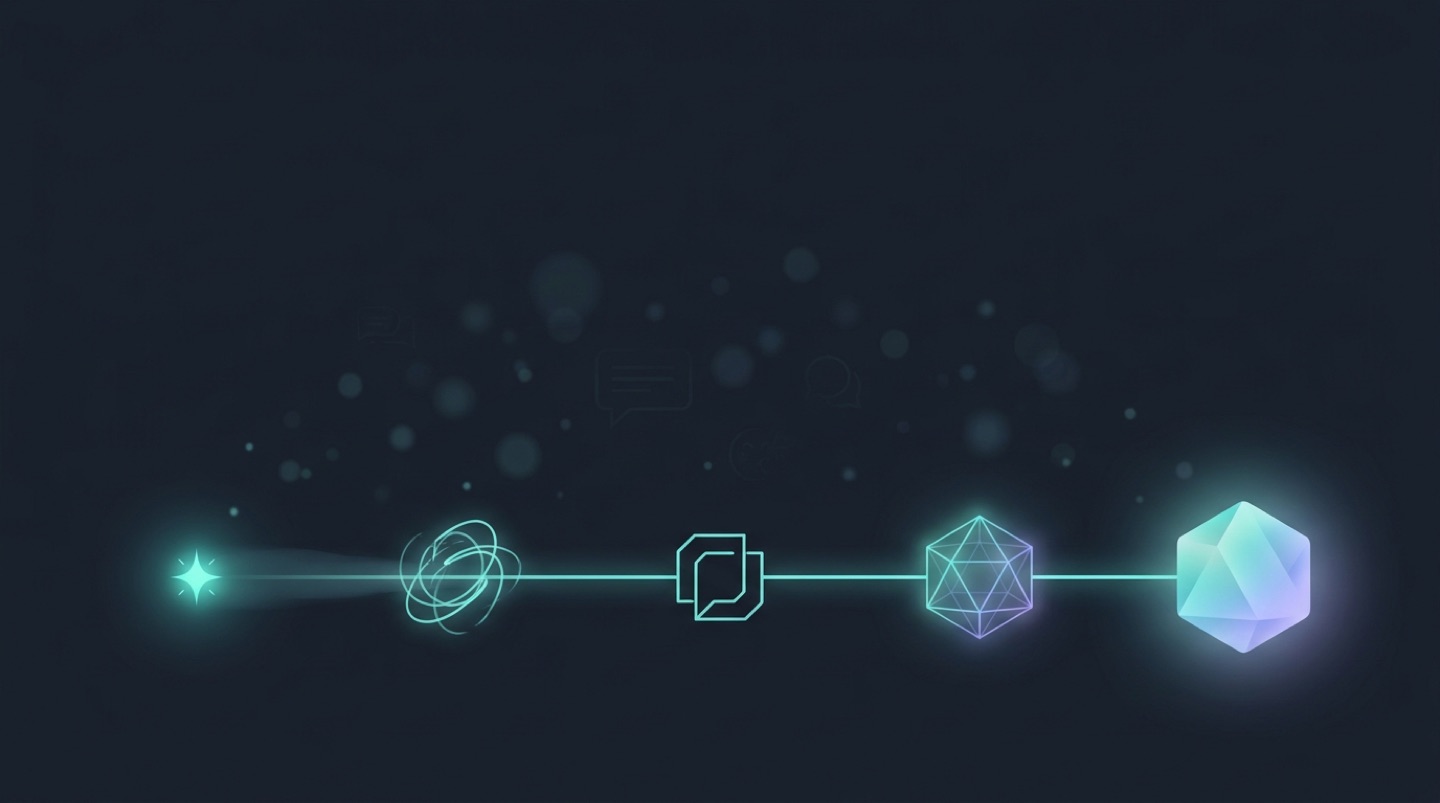
You are not short on ideas. Almost no one is. What you're short on is a reliable way to get an idea from the moment it strikes to the moment it becomes a real thing in the world. Most ideas die somewhere in that gap — and they die quietly, so you rarely notice how many.
This is a system for closing that gap. It's four steps — capture, clarify, research, act — and it works whether you run it on paper, in a notes app, or in a tool built for it. The steps matter more than the tools, so let's start there.
The system in one glance
- Capture — catch the idea in seconds, before it evaporates.
- Clarify — sharpen a vague notion into an idea you understand.
- Research — check it against reality with real sources.
- Act — attach a specific next step to a specific day.
Why ideas die (it's not laziness)
The instinct is to blame willpower — "I just never follow through." But watch where ideas actually leak out and you'll see it's structural, not moral. An idea has to survive four separate failure points, and dropping it at any one of them ends the journey:
- It's never captured — the thought arrives while your hands are full and is gone in a minute.
- It's captured but stays vague — a three-word note you can't act on and won't revisit.
- It's never checked — so you either over-commit to a dud or abandon a good idea out of doubt.
- It never becomes a next step — a note has no due date, no calendar slot, no reason to resurface.
Fix all four and ideas start converting. Here's how to run each step well.
Step 1 — Capture: win the first minute
There's a short window — often under a minute — between having an idea and losing it. The single most important property of your capture method is speed: every extra step between "I had an idea" and "it's saved" is a chance to lose it. If catching a thought requires unlocking, choosing a folder, and typing a title, you'll skip it exactly when it matters — mid-run, half-asleep, driving.
How to do it well:
- Use one capture inbox, not five scattered apps. Ideas you can't find later are ideas you didn't capture.
- Prefer voice for on-the-go — talking is faster than typing and works hands-free.
- Don't organize while capturing. Get it in first; sort later.
The goal is to make capturing an idea take less effort than losing it. (This is exactly why Thought Spark opens straight to a mic and auto-titles everything — see how capture works.)
Step 2 — Clarify: turn fog into an idea
A captured idea is almost always a first, half-formed take. "App that helps people cook." Okay — for whom? Solving what, exactly? Why would they switch? A tidier version of that note is still fog with better lighting. Clarifying is the work of asking the questions that turn a notion into something you can actually evaluate.
The fastest way to improve an idea is not to add to it — it's to answer three hard questions about it.
Run any raw idea through these:
- Who is it really for? Name a specific person, not "everyone."
- What's the honest why? What painful thing does it remove or valuable thing does it add?
- What has to be true? What's the riskiest assumption hiding underneath?
Answering these usually reveals that the idea is either sharper than you thought or quietly depends on something implausible — both are useful to know early. An AI can play this role well: instead of summarizing you, it interviews you. That's the entire premise of Thought Spark's Clarify — an AI that asks you questions rather than talking back at you. (For a standalone version of this method, see the AI interview method.)
Step 3 — Research: check it against reality
Before you spend a weekend on an idea, spend a minute on the question that stops most people cold: "Has someone already done this?" — and its more useful cousin, "where's the actual gap?" The usual way to answer is a spiral of open tabs that's slow enough that people skip it entirely. Don't. A little research, done fast, is the difference between building something needed and rediscovering something abandoned.
What to look for:
- Prior art — what already exists, and why it's not enough.
- The gap — the specific wedge where you'd be different, not just "better."
- Risks — the one or two things most likely to sink it (licensing, cost, distribution).
Insist on sources you can open — an unsourced answer isn't validation, it's a vibe. Thought Spark's Research does this in one tap and returns findings with real citations, which is the part most voice-note apps can't do at all.
Step 4 — Act: a specific step on a specific day
This is the step almost everyone skips, and it's the one that decides everything. Decades of behavior research keep landing on the same unglamorous finding: the reliable predictor of whether an intention becomes an outcome is an implementation intention — attaching a specific action to a specific time and place. "I'll work on it sometime" fails. "Draft the outline, Tuesday 9am" happens.
How to do it well:
- Reduce the idea to one next physical action — small enough to start in two minutes.
- Put it where you'll see it: your calendar and reminders, not a separate idea graveyard.
- Block time for the first step now, while the motivation is fresh.
Thought Spark's Act automates exactly this — it turns a developed idea into next steps and a calendar work-block written straight into Apple Reminders and Calendar.
Putting it together
The magic isn't any single step — it's the loop. Capture keeps ideas alive. Clarify makes them worth pursuing. Research keeps you honest. Act makes them real. Run the whole thing and your ratio of ideas-had to things-shipped changes dramatically, because you've plugged all four leaks instead of one.
You can run this system by hand, and you should start today with whatever you've got. But the friction of doing it manually — four apps, lots of copy-paste — is itself a fifth failure point. Building the loop into one place is why we made Thought Spark: capture, clarify, research, and act on an idea without it ever leaving your hand.
Run the whole loop in one app
Capture → clarify → research → act, on your iPhone. Free to start.
Download Thought Spark