You don't need more ideas. You need to know which one is worth a weekend.
Every founder has the list — twenty "what ifs" in a note somewhere, and no honest way to tell the real one from the shiny one. Thought Spark pressure-tests an idea in minutes, with sources, then puts the first real step on your calendar.
The founder's real problem
It was never idea generation — you're drowning in ideas. The problem is the gap right after: an idea lands during someone else's launch post or a Sunday walk, you jot three words, and then it waits. By the time you look again the excitement's gone, the context is gone, and you either over-commit to a dud because you never checked, or abandon a good one because doubt won. Both are expensive. Thought Spark is built to close that exact gap.
Your loop, start to finish
Catch it
Idea hits mid-scroll. One tap, say it out loud — "marketplace for X, but for Y" — it's transcribed and titled before you lose the thread.
Sharpen it
Clarify interviews you: who's it for, the honest why, the assumption it lives or dies on. Ten minutes and the fog is gone.
Check it
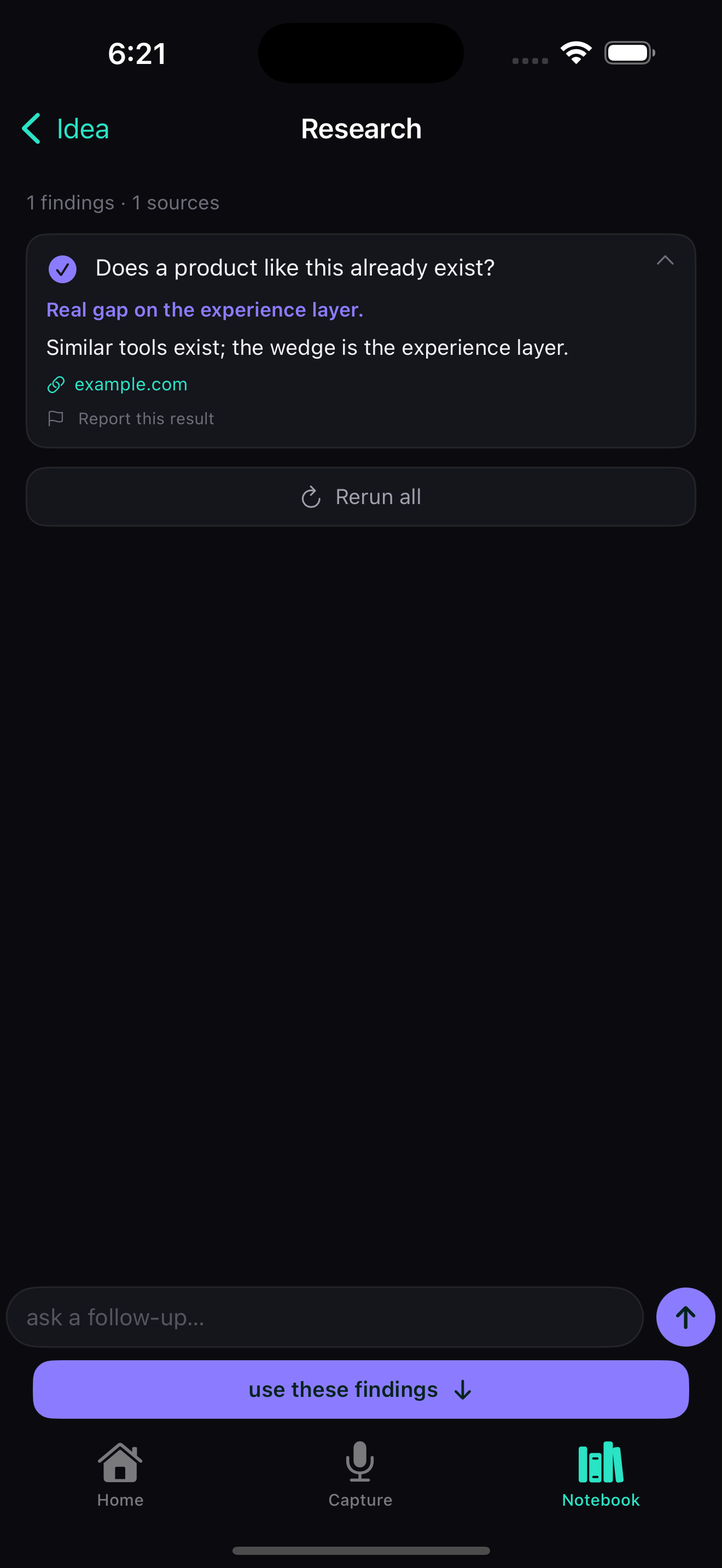
Research scans the web for prior art, the real gap and the risks — each finding with an openable source, not a vibe.
Move it
Act writes the first concrete step — "email 5 target users, Tuesday 9am" — into Reminders and Calendar. Now it's real.
The whole thing takes a coffee, not a weekend — which is the point. Cheap validation means you run it on every idea, not just the ones you've already fallen for.
The step that matters most for you: Research
"Has someone already built this?" is the question that kills momentum — and the one founders skip because the honest answer takes an afternoon of tab-hopping. Research collapses that into one tap: prior art, competitive context, and the risks worth planning for, each with a real citation you can open and check. You're not trusting a black box — you're getting a sourced first-pass so you can decide whether this one earns your time before you sink a weekend into it.
The cheapest thing a founder can do is find out an idea is taken — before building it, not after.
Fair questions
I already dump ideas in Notion / Apple Notes
And they're still sitting there, right? Storage isn't validation. A note holds the idea; it never tells you whether it's taken, where the gap is, or what the riskiest assumption is — and it never schedules the first step. Thought Spark is the part that happens after capture. Keep Notion; use this to decide what's worth putting in it.
Can it really validate a startup idea?
It does the honest first pass — prior art, context, risks, with sources. It doesn't replace talking to real customers; nothing does. What it does is make the first step fast enough that you actually reach the customer-conversation stage instead of stalling in doubt.
How is this different from just asking ChatGPT?
A chat window gives you an unsourced answer you'll close and forget. Here the loop stays with the idea: it interviews you to sharpen it, researches with citations, and writes the next step into your calendar. It's the difference between a conversation and a system.
Is my idea private?
Your ideas live on your device, not our servers. Content is sent for AI processing only at the moment you run a feature, and it's never used to train models. Details in the privacy policy.
Keep reading
Validate an idea in 15 minutes with AI
The fast sprint — frame, interview, research with sources, then decide.
Read the guide →How to turn ideas into action
The full capture → clarify → research → act system, tool-agnostic.
Read the guide →How Research works
Send an idea to the web and get findings back with real, openable sources.
See the feature →Find out if your idea is worth it — this week
Capture is free. Run one real idea through the loop and see what comes back.
Download Thought Spark